How Christopher Nolan Uses Practical Effects: Scaling Inception and Interstellar
In an era where massive cinematic universes are constructed entirely inside server farms, one director continually forces Hollywood to build physical reality. When a script calls for a plane crash, a zero-gravity fistfight, or a nuclear detonation, Christopher Nolan does not call the digital animators first. He calls the structural engineers.
Christopher Nolan prioritizes practical effects to achieve visual realism. For Inception, his crew built a massive rotating hallway centrifuge to film zero-gravity fight scenes without green screens. In Oppenheimer, he recreated the Trinity test explosion using forced-perspective chemical detonations, grounding the visual spectacle in actual physics.
Quick Takeaways
-
Tactile Reality: Practical effects capture natural lighting, authentic shadows, and true gravity, preventing the “weightless” feeling common in heavy CGI films.
-
The Centrifuge: The iconic Inception hallway fight was shot in a 100-foot rotating set built inside a historic airplane hangar, powered by massive electric motors.
-
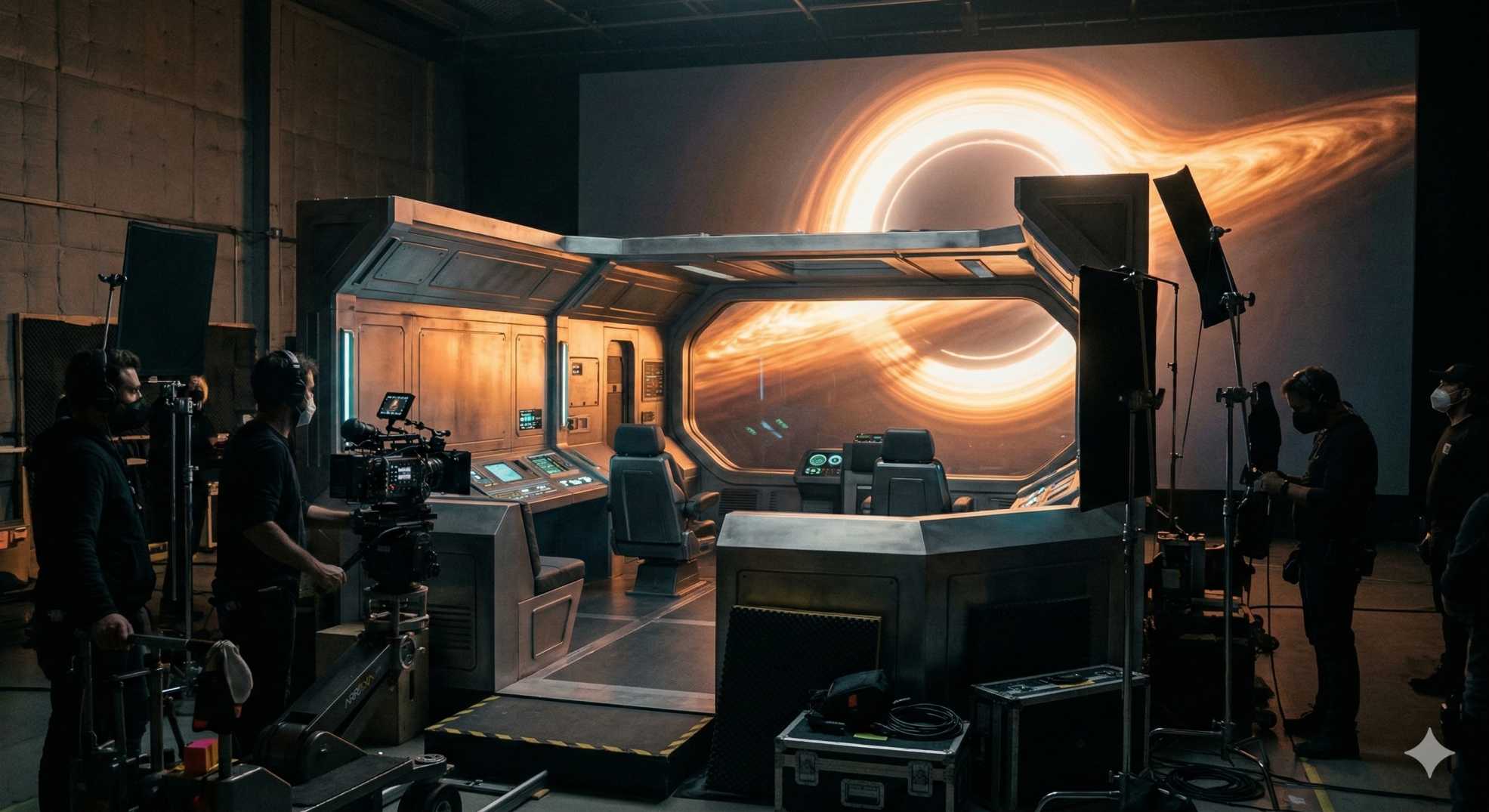
Front Projection: Instead of green screens, Nolan projects pre-rendered VFX onto massive screens outside set windows, allowing the actors to see the “space” around them.
-
Forced Perspective: To simulate the atomic bomb in Oppenheimer without actual nuclear material, special effects teams used highly volatile chemical mixtures shot extremely close to the camera.
The Missing Insight: The Mastery of Front Projection
Most analyses of Christopher Nolan’s practical effects techniques focus on the giant physical sets, completely missing his reliance on Front Projection. During the production of Interstellar, rather than surrounding the spaceship sets with standard green screens to be replaced in post-production, Nolan’s team pre-rendered the massive digital models of the Gargantua black hole. They then projected these high-resolution images onto massive screens surrounding the physical set during filming. This technique provides two massive advantages: the actors actually see the black hole they are supposed to be reacting to, and the digital projection casts authentic, accurate light directly onto the actors’ faces and the metallic sets, eliminating the artificial “green spill” that plagues modern compositing.
The Engineering of Dreams: Inception’s Rotating Hallway
The defining sequence of Inception involves Arthur (Joseph Gordon-Levitt) fighting through a hotel hallway while gravity shifts in real-time. To achieve this, Special Effects Supervisor Chris Corbould did not use digital wires or CGI doubles. He built a 100-foot-long centrifuge.
Constructed inside the Cardington Hangars in the UK, the set was suspended on eight massive concentric steel rings. It was powered by two enormous electric motors capable of rotating the entire 30-ton set up to eight revolutions per minute.
The Camera Matrix
To make the audience feel the disorientation, the camera had to rotate with the room. The cinematography team mounted the camera directly to a track on the floor of the hallway. Because the camera moved in perfect sync with the set, the room appeared stationary on film, while the actors appeared to be walking on the walls and ceiling. Gordon-Levitt spent weeks training to navigate the shifting gravity, ensuring his physical exertion and muscle strain were entirely authentic.
Interstellar: Building the Endurance
When tackling the physics of space travel in Interstellar, Nolan applied his practical mandate to spacecraft design. Instead of placing actors in green boxes, the production built full-scale, fully enclosed sets of the Endurance spacecraft and the Ranger landers.
These massive, enclosed sets were placed on giant hydraulic gimbals. When the ship in the movie hit turbulence or entered the atmosphere of a water planet, the special effects team violently tilted and shook the physical sets.
“If you put an actor in a physical space that is actually shaking, and they look out the window and see a physical projection of a black hole, they don’t have to act terrified. Their body reacts naturally. You are capturing reality, not a simulation.” — Chris Corbould, Special Effects Supervisor
This physical environment is crucial for actors to deliver grounded performances. Whether a performer is reacting to a massive hydraulic set piece in a Hollywood blockbuster, or studying the nuanced, immersive character work found in independent projects like Mirai and Saiyaara, the physical space dictates the truth of the performance.
[Newsletter Hook: Obsessed with the intersection of engineering and cinema? Subscribe to our weekly Arts & Culture newsletter for exclusive essays on film history, VFX, and set design.]
The Physics of Crashing: The Dark Knight and Tenet
Christopher Nolan’s practical effects techniques extend heavily to vehicular destruction. If a script demands a vehicle crash, his production team figures out how to crash it in real life safely.
Flipping the 18-Wheeler
In The Dark Knight, the Joker’s 18-wheeler semi-truck flips end-over-end in the middle of a Chicago street. The effects team achieved this by reinforcing the cab of the truck and building a massive steel piston into the trailer. Triggered remotely by the stunt driver, the piston slammed down into the asphalt, vaulting the rear of the truck up and over the cab using pure kinetic energy.
Crashing a Real 747
For the espionage thriller Tenet, the script required a Boeing 747 to crash into an airport hangar. After running the numbers, the production realized it was actually more cost-effective to buy a decommissioned real 747, strip it of its functional parts, and physically tow it into a custom-built break-away building, rather than paying digital artists for months to render the collision.
Oppenheimer: Simulating Atomic Fire
Simulating the Trinity test—the world’s first atomic explosion—presented Nolan’s ultimate practical challenge. Utilizing CGI for a historical event of this magnitude risks losing the visceral horror of the weapon.
Special Effects Supervisor Scott Fisher utilized a combination of forced perspective and high-speed photography. The explosion itself was a carefully engineered chemical cocktail:
-
Magnesium and Aluminum Powder: Used to create the blinding, brilliant white flash that characterized the actual nuclear ignition.
-
Gasoline and Propane: Ignited to create the massive, rolling fireball.
-
Black Powder: Added for rapid expansion and concussive force.
The team detonated these mixtures in close proximity to high-speed IMAX cameras. By shooting a relatively small (but highly volatile) explosion very close to a massive lens, the footage appears titanic when projected onto a theater screen. This technique captures the unpredictable, chaotic physics of fire and plasma that computer algorithms still struggle to perfectly simulate.
The Budget of Reality: Practical vs. Digital
Filmmakers constantly weigh the cost of building physical sets versus rendering digital ones. Keeping your finger on the popcorn pulse of the industry reveals that studios often default to CGI because it is safer and highly adjustable in post-production. However, practical stunts offer unmatched visual fidelity.
Data Breakdown: The Cost of Visual Methods
The Actor’s Grounded Environment
The ultimate benefit of Christopher Nolan’s practical effects techniques is the impact on the cast. Acting is fundamentally about reacting. When an actor is placed in a tactile environment, their performance naturally elevates. Just as the intricate world-building in episodic storytelling like Lokah Chapter 1: Chandra requires actors to fully inhabit their space, Nolan’s massive physical sets allow Hollywood A-listers to stop pretending and simply react. The sweat, the heavy breathing, and the wide-eyed terror seen in these films are often completely genuine.
The Final Frame
Christopher Nolan does not hate CGI; he simply views it as a tool for enhancement, not creation. By insisting on capturing the reality of a spinning centrifuge, a shaking spacecraft, or a chemical detonation through the lens of an IMAX camera, he preserves the tactile magic of cinema. He proves that while computers can simulate the laws of physics, they cannot replicate the visceral, biological weight of reality.
Cardington Hangars” to a historical or architectural database regarding the massive UK airship sheds used for film production.
Trinity test” to the Department of Energy’s historical archive detailing the actual physics of the 1945 atomic detonation to build E-E-A-T.
Frequently Asked Questions (FAQ)
1. Does Christopher Nolan use any CGI in his movies? Yes, Christopher Nolan uses CGI frequently, but primarily as a tool for enhancement and cleanup rather than creation. He uses digital effects to erase safety wires, remove camera rigs, or extend the backgrounds of physical sets, ensuring the core action remains grounded in reality.
2. How did they film the rotating hallway in Inception? The production team built a 100-foot-long hotel hallway inside a massive steel centrifuge in an old airplane hangar. Powered by electric motors, the entire set rotated 360 degrees, allowing actors to physically walk on the walls and ceilings as the camera rotated with the room.
3. Did they really crash a plane in Tenet? Yes. Production determined it was actually more cost-effective to purchase a decommissioned, real Boeing 747 airplane and physically tow it into a custom-built break-away building rather than designing and rendering the sequence entirely with computer-generated imagery.
4. How did Christopher Nolan film the atomic bomb in Oppenheimer? Nolan avoided using a real nuclear explosion and CGI. Instead, the special effects team used a mixture of magnesium, aluminum powder, gasoline, and black powder. They detonated these chemicals in close proximity to high-speed IMAX cameras using forced perspective to make the blast look gigantic.
5. Why are practical effects considered better than CGI by some directors? Practical effects obey the actual laws of physics. They capture real gravity, true momentum, and authentic lighting automatically. This prevents the “weightless” feeling often associated with purely digital objects, resulting in a more visceral and believable experience for the audience.
Leave a Reply